The house as weapon and ally
The War of the RosesThe house as weapon and ally names the transformation at the center of Oliver Rose and Barbara Rose’s domestic conflict: the home they fashioned together becomes both the property they fight over and an instrument they use against one another. Its meaning changes from an expression of shared life into a legal prize, then into a dangerous space whose rooms and objects are enlisted in their retaliations. The house does not literally choose sides, but each spouse treats intimate knowledge of it as a source of power and imagines its structures as an ally.
A shared creation and a contested asset
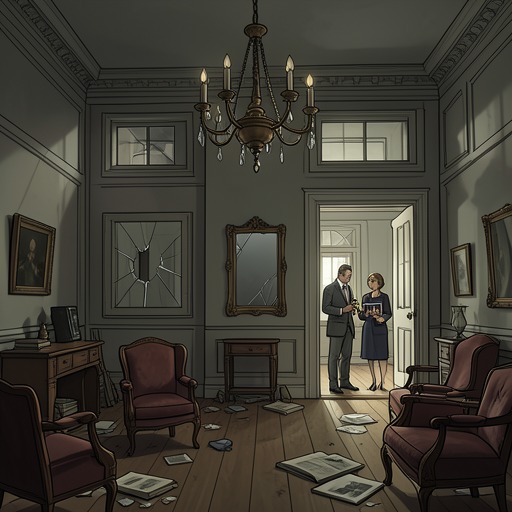
The Roses’ attachment to the house begins in its appearance and in the life they built around it. Its high ground-floor windows, ornamental ironwork beneath the second-floor sills, and dormers set into a weathering slate roof exceeded their expectations. They had a copperplate engraving made and sent it out each Christmas. The house seemed to express their identity as a couple: it was not merely a place they occupied, but a visible emblem of what they had made together.
Antique collecting reinforced that sense of joint authorship. Weekends took the Roses to auction houses and old Virginia and Maryland homesteads, while many European vacations were devoted to finding furnishings and objects. Memories of those trips accumulated among their possessions, giving the collection a personal history as well as monetary value. In the divorce discussions, therefore, the house and its contents represented both an estate to divide and the material record of a marriage.
Their practical investment was also shared. Barbara Rose had learned cooking from her mother and from summer work with professional cooks and bakers, and she began imagining a catering business as the children needed less of her time. She designed a kitchen with commercial use in mind. Oliver Rose threw himself into its construction, applying his electrical and craft skills; Barbara Rose learned how the equipment worked and became proficient at household repairs. Oliver Rose had given her a tool chest, and she had helped him build the basement sauna and its adjoining shower. Their shared handiwork complicates the later struggle: the rooms and systems available as weapons were also products of cooperation.
Law turns home into a prize
The financial negotiations make the house’s double status explicit. Oliver Rose told Murray Goldstein that the house might be worth at least half a million dollars, with the antiques worth another half-million or more. He initially said that half the value of the house and possessions would be acceptable, describing them as things the couple had created together. Yet a settlement based on market value would not give Barbara Rose the house itself. Harry Thurmont explained that an independent appraisal would establish the value, after which Oliver Rose could borrow money and make a lump-sum payment. Barbara Rose understood that cash and a home were not interchangeable: she had spent nearly twenty years supporting Oliver Rose’s career, raising their children, and devoting substantial effort to the house, while believing that he could eventually replace its value more readily than she could.
The rules of divorce altered how the Roses could inhabit the contested property. Murray Goldstein explained that Title 16-904, Section C permitted a no-fault divorce while the spouses lived under one roof, provided they lived separately; the waiting period remained in place. But residence did not settle ownership. A judge might order the house and its contents sold and divide the proceeds, while a property dispute could continue separately from the divorce. Oliver Rose seized on the possibility of staying in the house as a way to demonstrate his determination to keep it, even as he recognized that living there with Barbara Rose could become a nightmare.
Legal orders also reached into ordinary domestic movement. After Barbara Rose charged Oliver Rose with harassment and violation of their maintenance agreement, an injunction required her to keep business expenses separate from household money. In a separate dispute, she obtained an injunction forbidding him from breaking into her room. That ruling changed a room into a legally protected boundary inside the shared home; their son Josh Rose worried that his father might be jailed if he violated it. The house thus became a setting where formal rules governed access, money, and the use of space, rather than a refuge beyond the reach of the divorce.
Familiar rooms become instruments of retaliation
As the conflict escalates, the Roses turn domestic work and household objects toward reprisal. After Barbara Rose destroys Oliver Rose’s orchids, he enters her kitchen and alters seven meat loaves with large quantities of spices, using ginger, curry powder, salt, and sugar in different combinations. The act targets food prepared for Barbara Rose’s customers: her professional kitchen, designed to support her independence, becomes the scene and mechanism of sabotage. The retaliation is not separate from the house’s ordinary purpose; it corrupts the equipment and work of cooking on which her business depends.
Barbara Rose uses the architecture in turn. When Oliver Rose goes into the sauna, she wedges a chisel into the crack of its heavy redwood door with a wooden mallet, trapping him inside. The episode turns a room he had helped build into confinement. The same materials that once signified craft and shared effort now allow one spouse to restrict the other’s movement. In this pattern, familiarity with the house has a practical edge: rooms, doors, tools, and appliances can be repurposed without leaving the contested property.
Later, Oliver Rose’s retaliations expand into a larger system of hazards. Barbara Rose enters through a broken sun-room window and finds the kitchen rearranged. When she pulls a rope, pots crash down; on the marble floor her feet lose their grip, and a refrigerator nearly falls on her. The basement stairway has been altered, forcing her to cling to the banister and brace herself against the walls before she can reach the floor. The house she knows becomes difficult to read because its familiar arrangements have been replaced by concealed dangers. Trapped in the workshop by a wedged door, she finds a sledgehammer and breaks her way out.
Competing claims of alliance
Oliver Rose’s idea of the house as an ally takes shape when he is injured and trapped in the sauna. Lying on its built-in redwood bench, he mentally maps the house’s rooms, pipes, and wires. He believes he knows it better than Barbara Rose and concludes that, if the house is to be a weapon, he can devise more horrors with its systems. His confidence rests on two claims at once: that the property is his, and that intimate knowledge gives him strategic command of it. In the same sequence, he searches for materials such as silicone spray and lubricating oil, treating stored household supplies as resources for the next stage of the conflict.
Barbara Rose also imagines the house as her ally. From the attic, she listens to Oliver Rose moving furniture and setting traps below, mapping his activity from its sounds. She believes that the house is on her side and that his contrivances cannot truly harm her; her confidence turns the same architecture that endangered her into a source of anticipated advantage. Her strategy depends on tenacity, concealment, and listening, not on controlling every mechanism. The spouses therefore share a belief in the house’s allegiance even as they give that imagined allegiance opposite meanings.
Meaning of the house as weapon and ally
The house’s transformation ties property, labor, and power together. Its market value can be appraised and divided, but neither spouse experiences it as an interchangeable sum. For Barbara Rose, it embodies a life-style and years of largely unpaid contributions that she fears cash alone cannot replace. For Oliver Rose, staying in it becomes a means of asserting his claim and refusing to surrender the asset. Their legal dispute over ownership is therefore also a struggle over who may remain, who may control the rooms, and whose knowledge of the home counts as authority.
The metaphor is most unsettling because the house is not an unfamiliar battlefield. The Roses’ knowledge of its construction and routines comes from years of shared living, collecting, repair, and improvement. As those familiar features are turned against them, cooperation becomes part of the conflict’s material history: the skills and spaces once used to make a household function now support confinement, sabotage, and evasion. Calling the house an ally captures the spouses’ attempts to make a shared world serve individual survival, while the house’s conversion into a trap exposes the cost of treating common life as territory to be won.